





Long before the Himalayas rose and long before India joined the Asian mainland, a massive predator ruled the land. That predator was Rajasaurus, a dinosaur whose name literally means “king lizard.” If you’ve ever wondered whether India had its own version of Tyrannosaurus rex, the answer lies in the story of this ancient creature, one of the most important fossil discoveries ever made on the Indian subcontinent.
This article breaks down everything worth knowing about it — the discovery, appearance, hunting habits, and eventual extinction of this remarkable animal. Whether you’re a student, a parent answering a curious kid’s questions, or simply a dinosaur enthusiast, you’ll find clear, accurate, and engaging information here.
What Is Rajasaurus? A Quick Overview
Rajasaurus was a large, carnivorous theropod dinosaur that lived in what is now western India during the Late Cretaceous period, roughly 67 million years ago. It belonged to a group called abelisaurids, a family of stocky, short-armed predators that also included famous relatives like Carnotaurus from South America and Majungasaurus from Madagascar.
The genus name comes from the Sanskrit word “raja,” meaning king, combined with the Greek word “sauros,” meaning lizard. The species name, narmadensis, refers to the Narmada River valley in Gujarat, where its bones were first unearthed.
Why This Dinosaur Matters to Paleontology
This “king lizard” isn’t just another entry on a long list of dinosaur names. It represents the first dinosaur skull ever reconstructed from Indian fossil material. Before this discovery, scientists knew dinosaurs had lived in India, but isolated bones made it nearly impossible to picture what any single species actually looked like. This find changed that completely.
The Discovery of Rajasaurus: A Story Decades in the Making
The fossils were first excavated between 1982 and 1984 by geologist Suresh Srivastava, who found bones in a cement quarry near the village of Rahioli, close to Balasinor in Gujarat. The site sits within the Lameta Formation, a rock layer known for preserving Late Cretaceous fossils from a time when India was still an isolated island drifting toward Asia.
Despite the early discovery, the dinosaur wasn’t formally studied and named until 2003. A team led by paleontologist Jeffrey Wilson, working alongside Paul Sereno and Indian researchers, spent years piecing together the fragmented skull. Additional remains were later found near Jabalpur in Madhya Pradesh, further confirming the species across a wider region.
This gap between discovery and formal naming is common in paleontology. Reconstructing a skull from broken, scattered fragments takes patience, expertise, and often international collaboration — exactly what happened here.
What Did Rajasaurus Look Like?
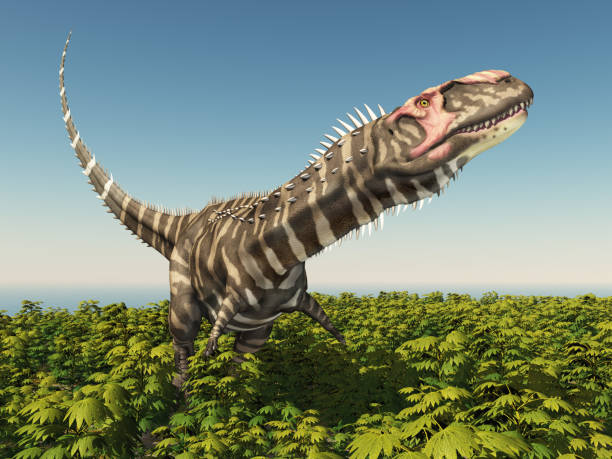
Picture a powerfully built, two-legged predator with a thick skull, short arms, and a long, muscular tail. That’s this dinosaur in a nutshell.
- Length: Estimates have varied over the years. Early calculations suggested up to 30 feet (9 meters), while more recent studies based on limb and vertebra measurements place it closer to 23–24 feet (7.1–7.4 meters).
- Weight: Roughly 3 to 4 tons, comparable to a large elephant.
- Skull: Short, deep, and robust, with a small bony crest or horn-like bump above the eyes, likely used for display or dominance signaling rather than combat.
- Arms: Short and reduced, a hallmark trait of abelisaurids.
- Legs: Long and powerful, built for speed and stability while chasing prey.
The crest is one of its most distinctive features. Many paleontologists believe it functioned similarly to a peacock’s tail or a lion’s mane — a way to attract mates or intimidate rivals rather than a weapon.
How Rajasaurus Compares to Its Relatives
It shares a striking resemblance to Majungasaurus, a similarly built predator found in Madagascar. This similarity isn’t a coincidence. It offers strong evidence that India and Madagascar were once physically connected as part of the ancient supercontinent Gondwana, separating only a short time before this species roamed the earth.
How It Hunted and What It Ate
This dinosaur was an apex predator, meaning it sat at the top of its local food chain. Its primary prey likely included titanosaurs, the long-necked, herbivorous sauropods that also lived in the Narmada region during the same period. Fossils of both dinosaurs have been found close together, and fossilized dung from titanosaurs found nearby gives researchers extra clues about the broader ecosystem.
Given its short snout and strong neck and jaw muscles, scientists believe it used an ambush-and-bite hunting style, somewhat like modern big cats. It likely relied on powerful bite force rather than a prolonged chase, delivering short bursts of speed before overpowering prey with sheer strength. Some researchers also suggest it may have scavenged when the opportunity arose, a common behavior among large theropods.
Benefits of Studying Rajasaurus
Understanding this ancient predator offers more than just trivia for dinosaur fans. Here’s why the discovery genuinely matters:
- Fills a major gap in Indian paleontology. Before this find, India had almost no complete dinosaur skeletons on record.
- Confirms continental drift theories. Its similarities to Madagascan dinosaurs support the Gondwana breakup timeline.
- Reveals extinction clues. It helps scientists study how volcanic activity affected dinosaur populations before the asteroid impact.
- Inspires future exploration. The discovery encouraged further fossil hunting across central and western India.
- Educates the public. It gives Indian students and museums a homegrown dinosaur icon to study and celebrate.
Common Mistakes People Make About Rajasaurus
Even enthusiastic dinosaur fans get a few things wrong. Watch out for these common misconceptions:
- Confusing it with Indosuchus. Some early skull fragments were originally misidentified as belonging to that genus before researchers realized they represented a distinct species.
- Assuming it was the largest predator ever. This dinosaur was significant, but it was smaller than giants like Tyrannosaurus rex or Giganotosaurus.
- Believing the crest was a weapon. Most experts agree it was a display feature, not a combat tool.
- Thinking all Indian dinosaurs went extinct with the asteroid. Evidence suggests Indian dinosaur populations, including this species, may have declined roughly 350,000 years before the mass extinction event, likely due to intense volcanic activity from the Deccan Traps.
- Overestimating fossil completeness. While the find was groundbreaking, only about 70% of the skeleton has actually been recovered.
Expert Tips for Learning More About Rajasaurus
- Visit a natural history museum. Reconstructed skull casts are displayed in institutions like the Geological Survey of India and international museums with Indian fossil exhibits.
- Read peer-reviewed sources first. Start with the original 2003 scientific description before relying on secondary summaries.
- Compare it with abelisaurid relatives. Studying Carnotaurus and Majungasaurus alongside this species gives a clearer picture of how the dinosaur family evolved across continents.
- Follow updated size estimates. Paleontology is an evolving science, and length estimates have been revised more than once as new studies emerge.
- Explore the Deccan Traps. Understanding this massive volcanic region helps explain the environmental pressures the species faced near the end of its existence.
India’s King Lizard vs Other Famous Theropods
| Feature | Rajasaurus | Tyrannosaurus rex | Majungasaurus |
|---|---|---|---|
| Region | India | North America | Madagascar |
| Time Period | ~67 million years ago | ~68–66 million years ago | ~70–66 million years ago |
| Length | ~23–30 ft | ~40 ft | ~20–23 ft |
| Weight | 3–4 tons | 8–9 tons | 1–2 tons |
| Distinct Feature | Bony head crest | Massive skull and bite force | Short snout, blunt teeth |
| Family | Abelisauridae | Tyrannosauridae | Abelisauridae |
This comparison shows that while India’s own king lizard wasn’t the biggest predator of its time, it was a formidable hunter well suited to its environment.
Frequently Asked Questions About Rajasaurus
What does the name Rajasaurus mean?
It means “king lizard.” The name combines the Sanskrit word “raja,” meaning king, with the Greek word “sauros,” meaning lizard. The full species name, Rajasaurus narmadensis, references the Narmada River valley in Gujarat, India, where the fossils were originally discovered between 1982 and 1984.
When did it live?
This dinosaur lived during the Late Cretaceous period, roughly 67 to 65 million years ago. This places it among the last dinosaurs to exist before the mass extinction event that ended the age of dinosaurs, and evidence suggests Indian dinosaur populations may have declined even earlier due to volcanic activity.
How big was it?
Estimates vary depending on the study, but this predator likely measured between 23 and 30 feet long and weighed around 3 to 4 tons. Earlier estimates leaned toward the larger end, while more recent research using bone measurements suggests a slightly smaller, though still powerful, hunter.
Where was Rajasaurus discovered?
The fossils were found in the Lameta Formation near Rahioli village, close to Balasinor in Gujarat, western India. Additional remains were later discovered near Jabalpur in Madhya Pradesh, confirming that this dinosaur inhabited a fairly wide region across ancient India.
What did it eat?
It was a carnivore that likely preyed on titanosaurs, large long-necked herbivorous dinosaurs that shared its habitat. Its strong jaw and neck muscles suggest an ambush hunting style, and it may have scavenged carcasses when live prey wasn’t available.
Is Rajasaurus related to Tyrannosaurus rex?
No, it is not closely related to T. rex. It belongs to the abelisaurid family, a group of theropods more closely related to dinosaurs like Carnotaurus and Majungasaurus than to tyrannosaurs, which evolved separately in North America and Asia.
Why is Rajasaurus important?
This dinosaur is significant because it produced the first reconstructed dinosaur skull from Indian fossil material. It also provides strong evidence linking India and Madagascar through the ancient supercontinent Gondwana, helping scientists better understand continental drift and prehistoric biogeography.
Does Rajasaurus have a crest or horn?
Yes, it had a small, bony crest above its eyes. Most paleontologists believe this feature was used for display purposes, such as attracting mates or signaling dominance, rather than as a weapon for fighting or hunting.
Summary
Rajasaurus stands as one of the most important dinosaur discoveries to ever come out of India. From its dramatic decades-long journey from excavation to formal identification, to its role in confirming ancient continental connections, this “king lizard” offers far more than just an interesting name. It’s a window into a lost prehistoric world where India was still an island, drifting slowly toward its modern location, ruled by a powerful predator built for speed, strength, and dominance.
If this deep dive sparked your curiosity, keep exploring. Visit a natural history museum near you, check out documentaries on Indian paleontology, or dig into the original scientific papers for an even deeper understanding of this remarkable dinosaur.
Discover more trending content only on WorldSnipes.